
Do you ever question when to use a comma? Is the right punctuation a colon or a semicolon? Different levels of writing may suggest different uses, but here are some common rules you might find handy.
Periods. They go at the end of most sentences, unless you’re injecting excitement or asking a question. But, where else does a period go?
A period can go at the end of an abbreviation and sometimes in one.
Mr.
Capt.
intro.
etc.
p.m. or a.m.
If your abbreviation ends the sentence, then that’s another story. A second period is not needed.
We'll stop at 4 p.m.
Question marks. We use these squiggly marks at the end of a sentence when we’re asking direct questions. A question mark isn’t necessary, however, when you have an indirect question.
Where did you find your shoes?
The girl asked where you found your shoes.
If you’re really not sure of a detail in your communication, a question mark in parentheses (brackets) may be the way to go.
There were six (?) cookies remaining.
Exclamation marks. An exclamation mark conveys emotion. You might be excited or maybe you want to emphasize a point.
I can't wait to see you!
You're amazing!
You got that right!
The comma. There are so many uses for a comma. It can set apart independent thoughts, let you know when to pause and take a breath, or allow you to insert information.
The teacher, who is pretty sharp, led the morning lesson.
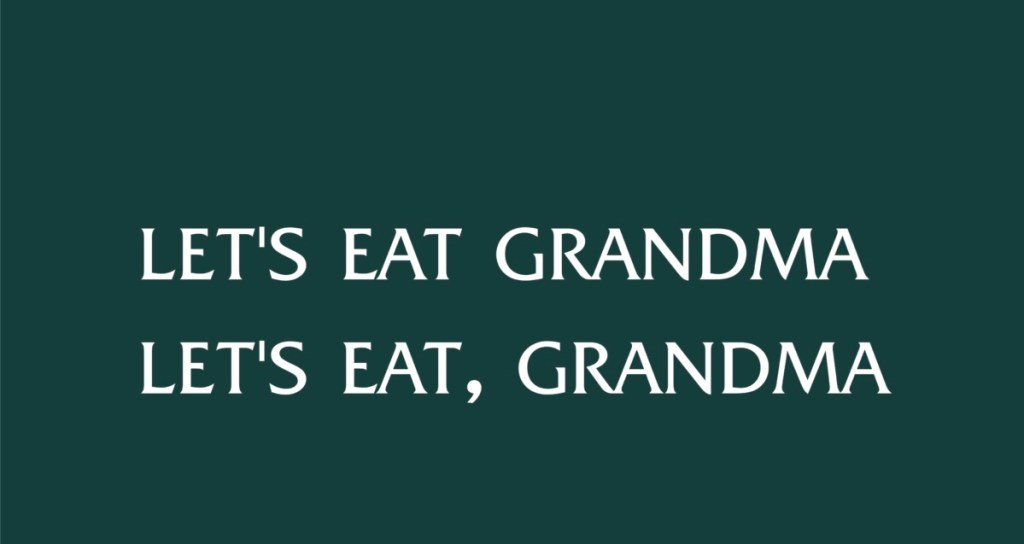
Proper use helps clarify the intent of your sentence! I’m sure no one wants to eat Grandma!
You’ll find commas separating independent clauses — clauses that can stand alone, yet they’re separated by conjunctions like and, but, or, so, etc.
The red schoolhouse is usually closed, and it's not used often.
There’s a lot to consider when placing commas. For example, if the clauses are short and easily understood together, you most likely don’t need a comma. It’s all about readability.
The boat leaves the dock at 2 p.m. and returns before sunset.
Another common use for the comma is to divide words or phrases in a list.
Bring home eggs, milk, bread and butter.
Notice how I didn’t use a comma before and? To me, the addition of butter is easily understood. This is a rule that comes with a lot of debate.
The semicolon. The semicolon can be used instead of a comma where you’re linking independent clauses related to the subject. They generally have a similar grammatical structure. You can also use a semicolon before a transitional phrase such as however.
Trails through the forest have natural beauty; trails in the city have architectural beauty.

There is no hot water in the cottage; however, you can find some in the main cottage.
You wouldn’t use a semicolon after a dependent clause, however.
Once the girls were ready to start, however, they continued to the next stage.
The colon. Cute and purposeful. The colon helps to set up information that’s to follow.
The writer introduced three books: A Comedy for Mary, My life with Bob, and The Giant Truth.
Colons are not necessary after words (like such as) that introduce the topic.
I enjoy a number of activities, such as baseball, rowing and hiking.
Using the right punctuation helps improve the readability of your copy. A simple comma in the wrong place could change the meaning of what you’re trying to express. Read back what you’ve written. Are your pauses in the right place? Are you missing a comma, or do you have too many commas interrupting the flow of your sentence?
This is just a sampling of punctuation available to you. How sharp are you when it comes to these small and mighty grammatical cues?
 My writing booth.